
Propagation
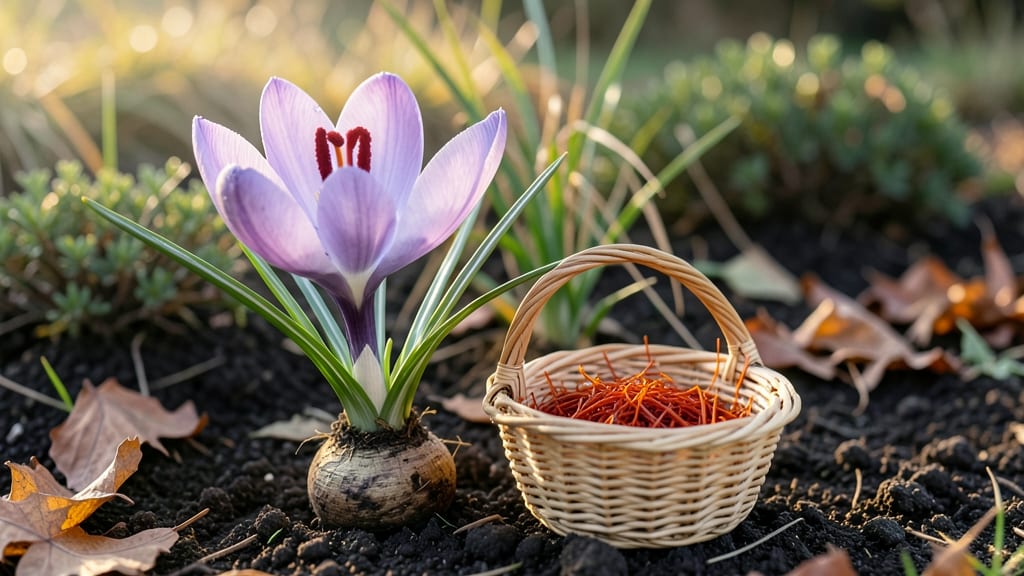
Saffron comes from the Crocus sativus flower, where its three delicate red stigmas are meticulously hand-picked to create the world’s most prized spice. Thousands of flowers are needed to produce just one pound of saffron.
This tiny flower packs a massive flavor punch because its stigmas contain high concentrations of crocin (the pigment), safranal (the aroma), and picrocrocin (the taste). 🌼 The harvesting process is painstaking—workers must pluck each stigma individually, often using tweezers, to avoid damaging the delicate threads.
What makes saffron so valuable isn't just its rarity, but how its unique compounds interact to create that unmistakable aroma and deep golden hue in dishes.
Fun fact: the Crocus sativus plant is actually sterile, meaning it can't reproduce from seeds. Farmers rely on corms (bulb-like roots) to propagate new plants, which adds another layer of complexity to growing saffron.
This botanical quirk explains why high-quality saffron often comes from specific regions like Iran, where centuries of cultivation have perfected the growing conditions.
💡 In This Article
- The Science Behind Saffron’s Stigmas and Harvesting
- Growing Saffron Crocus: Cultivation Tips for Gardeners
The science behind saffron’s stigmas and harvesting
The Crocus sativus flower has a unique botanical structure where only the three vibrant red stigmas are used for saffron. These stigmas are part of the flower's reproductive system, located at the center surrounded by six purple petals and six stamens.
What makes them special is their high concentration of volatile compounds—up to 150 aroma compounds in total—including safranal (responsible for its distinct aroma) and crocin (the pigment that gives saffron its golden color). The petals and stamens contain none of these valuable compounds, making them useless for spice production. 🔥
Harvesting these delicate stigmas is a meticulous process that requires precision. Each flower's stigmas must be plucked by hand within hours of blooming, typically between 7 AM and 9 AM, when they're at their freshest.
Workers use their fingers or tiny tweezers to avoid damaging the threads, which can be as long as 3 centimeters. What most people don't realize is that the drying process is equally critical—stigmas must be dried in the shade within 24 hours to preserve their flavor and color.
Overheating or direct sunlight exposure can destroy up to 50% of the volatile oils that define saffron's quality.
Climate and altitude play a crucial role in saffron's development. The best saffron comes from high-altitude regions like Iran's Khorasan province (1,500-2,000 meters above sea level), where cooler temperatures slow plant growth and concentrate the flavor compounds.
At these elevations, the days are shorter and nights colder, which triggers the plant to produce more safranal during its dormancy period. This natural process creates what experts call "terroir"—the unique environmental factors that give Persian saffron its superior depth of flavor compared to saffron grown at lower altitudes.
Here's what happens when you examine the chemical composition: The stigmas contain approximately 0.2-0.5% essential oils by weight, with safranal making up about 50-70% of these oils.
The remaining compounds include pinene (which contributes to the spice's fresh, herbal notes) and picrocrocin (the bitter glycoside that gives saffron its characteristic sharpness). When properly dried, these compounds remain stable for years, which is why high-quality saffron can be stored for decades without losing potency. ✨
The labor intensity becomes clear when you consider that it takes about 75,000 flowers to produce just one pound (0.45 kg) of saffron. This translates to roughly 225 million flowers per metric ton!
The process also explains why saffron is so expensive—it's not just about the rarity of the flower, but the incredible amount of human effort required to transform those delicate stigmas into the spice we know.
What's fascinating is how this labor-intensive process actually enhances the final product, creating a spice that's unmatched in flavor complexity.
For those curious about the botanical details, the Crocus sativus plant belongs to the Iridaceae family and is actually a triploid species, meaning it has three sets of chromosomes instead of the usual two.
This genetic quirk makes it sterile and unable to reproduce sexually, forcing farmers to rely entirely on vegetative propagation through corms.
The plant's life cycle is also unique—it spends most of its time underground as a dormant corm, only emerging for about 6-8 weeks each autumn to bloom and produce saffron. 💫